
The pattern is familiar. Lunch was plain - chicken, rice, vegetables. By 3 pm your waistband is tight and you feel blown up like a balloon. Yesterday you ate far more, and nothing happened.
So you start cutting foods on suspicion. Garlic goes. Then dairy. Then bread. A month later the bloating is still there, your meals are smaller and sadder, and you still do not know what causes it.
The problem is not effort. It is evidence. Memory keeps the worst days and forgets the calm ones, and bloating often arrives hours after the meal that set it off. A written diary fixes both problems at once.
Why Guessing Your Triggers Fails
- The lag. Symptoms can build over several hours. The food you blame is often the last thing you ate, not the meal that started it.
- The dose. Many foods only cause trouble above a portion size. A food can be fine on Tuesday at a small serving and a problem on Friday at a large one.
- The stack. Several borderline foods in one day can add up, even when each one is fine alone.
- The other factors. Meal size, eating speed, carbonated drinks, stress, and poor sleep can all sit behind a flare that looks like a food problem.
A diary does not remove those problems. It records them, so you can separate them instead of guessing.
What to Record: The 7 Fields That Matter
Keep the diary small enough to actually use. These seven fields are the set that makes pattern-finding possible.
| Field | What to write | Why it matters |
|---|---|---|
| Time | The time you ate, and the time symptoms started | Connects a flare to the hours before it, not just the last meal |
| Food and drink | Everything, including sauces, snacks, and drinks | Hidden ingredients - onion in a sauce, sweeteners in a drink - are common suspects |
| Portion | A real amount: cups, grams, slices, pieces | Dose decides many triggers; "some cheese" cannot be compared across days |
| Bloating score | 0 to 10 at check-in times, not only when it is bad | Calm-day scores are the baseline every flare is judged against |
| Other symptoms | Gas and pain scores, if you can | Some foods track with gas, others with pain; the split is useful evidence |
| Meal context | Very large meal? Ate fast? Fizzy drinks? | Stops non-food causes being blamed on food |
| Day context | Sleep, stress, and medicines in one short note | A bad week can look like a food trigger if this line is missing |

You can check the FODMAP side of any food as you log it in our free FODMAP Food Chart, which covers 221 foods, and our gut health hub collects the rest of our gut-health guides.
How to Keep the Diary in 5 Steps
- 1. Log at the meal, not at bedtime. Portions and small items are the first things memory drops.
- 2. Check in on a schedule. Score your bloating at set times - after meals and in the evening, for example - including on good days.
- 3. Change nothing at first. Eat normally for the first week. A diary kept while you are also cutting foods cannot tell you which change did what.
- 4. Keep it for at least a week. Patterns need repeats. One flare is a data point, not a verdict.
- 5. Read it weekly, not daily. Judge foods on how often flares followed them across the whole week, compared with how often you flared overall.
The 6-Hour Window: Why Timing Changes Everything
Here is the reading habit that matters most. When bloating spikes, do not ask "what did I just eat?" Ask "what did I eat in the hours before this started?"
Food moves and ferments on its own schedule. A lunch can be behind a late-afternoon flare. Looking back over a window of several hours - Bloat Detective uses 6 hours - lines the suspects up fairly.

The window also protects innocent foods. If a food appears before flares but also on just as many calm days, it is probably not your trigger.
How to Read the Diary and Spot a Real Pattern
A real suspect has to pass three tests before it earns a place on your trigger list.
- Repeats. Flares followed the food at least 3 separate times. Once is noise.
- Beats your baseline. You flared more often after this food than you flared in general. If you bloat most days, most foods will sit before a flare by chance.
- Makes sense on dose. Bigger portions were followed by bigger scores, or the food only appears before flares at large servings.
Foods that pass all three are worth a careful test - a short pause, then a planned reintroduction - ideally with a dietitian. Foods that pass none of them go back on the menu. That second part matters: a good diary gives foods back as often as it takes them away.

If you are also exploring the low FODMAP approach, our beginner guide to the low FODMAP diet and our guide to low FODMAP eating for gas and bloating show how a diary and the 3-phase protocol fit together.
Trigger Categories Worth Watching
These are categories to watch in your records, not a list to cut on sight. Your diary decides which ones, if any, are yours.
- Fructans. Onion, garlic, and wheat at normal servings - the most common fermentable group in everyday meals.
- Lactose. Regular milk, soft cheese, and regular yogurt, if you digest lactose poorly.
- Excess fructose and polyols. Large serves of some fruits and juices, and the sorbitol and mannitol in sugar-free gum, mints, and sweets.
- Beans and lentils at large servings. High in galacto-oligosaccharides, which ferment in the gut.
- Carbonated drinks. The gas goes in with the drink; the diary often shows it plainly.
- Very large or very fatty meals, eaten fast. Not a food group at all - a meal pattern, and one a diary catches well.
5 Diary Mistakes That Hide the Answer
- Only logging bad days. Without calm days there is no baseline, and every food looks guilty.
- No portions. "Pasta" on a calm day and "pasta" on a flare day may be two very different amounts.
- Cutting foods while you track. If three foods leave the menu in week one, the diary can never separate them.
- Judging after one flare. A single bad afternoon has too many possible causes to name one food.
- Never reading it back. A diary that is written and never compared is just a list. The weekly read is where the value is.
Want the Pattern-Finding Done for You? Meet Bloat Detective
A food and symptom diary that cross-references your meals for you
A paper diary stores what you write. It does not do the maths. Bloat Detective logs the same records, then does the comparison work: when your bloating hits 6 or higher, it looks back over the previous 6 hours, tallies every food and FODMAP group you ate, and shows you which ones were followed by flares more often than your own normal rate - with the evidence dates attached.
What it does for you
- Log meals in seconds from a built-in 221-food database, each food already tagged by FODMAP group - or add any food as free text.
- Quick check-ins for bloating, pain, gas, and energy, so flare days and calm days are both on record.
- The Detective view unlocks after 10 meals and 10 check-ins across at least 5 days, and a food is only named a suspect after at least 3 exposures - no one-flare verdicts.
- A personal trigger list and a printable report you can take to your doctor or dietitian. Your data stays private in your own browser; we never see it.
Good to know
- It costs $19 once, with no subscription, and a 7-day money-back guarantee.
- It shows patterns to explore, never diagnoses. Only structured elimination and reintroduction can confirm a trigger.
One Small Support
Bloat Detective above is the main tool. This one item is just a support for keeping the diary itself, and it is secondary.
A digital kitchen food scale
Portions are the field most diaries get wrong, and a small scale fixes that in seconds - oats, cheese, fruit, and nuts become real numbers instead of guesses. We read many real Amazon customer reviews before listing this pick. Choose a scale that weighs in grams and has a flat, easy-clean surface.
Check price on AmazonA note on what a diary can and cannot do: A food diary may help you spot patterns worth testing. It does not diagnose a food intolerance or any other condition, and bloating has many possible causes beyond food. If you have blood in your stool, unexplained weight loss, severe or worsening abdominal pain, persistent vomiting, fever, or symptoms that wake you at night, see a doctor promptly rather than tracking them in a diary.
Questions, answered
What should a food diary for bloating record?
Record the time, everything you ate and drank, the portion, and a symptom score from 0 to 10 for bloating. Add when symptoms started, plus gas and pain scores if you can. That set is enough to compare flare days with calm days and spot repeats.
How long should you keep a food diary for bloating?
At least a week of light, honest logging is a useful start. Bloat Detective, for example, unlocks its pattern view after 10 meal entries and 10 symptom check-ins across at least 5 different days, and only shows a suspect food after at least 3 exposures. More days make the pattern stronger.
How soon after eating does bloating usually show up?
It varies. Symptoms can start soon after a meal or build over the next few hours, which is why blaming the last thing you ate is unreliable. Reading a diary means looking back over the hours before a flare. Bloat Detective uses a 6-hour look-back window for that reason.
Can a food diary diagnose a food intolerance?
No. A diary shows patterns in your own data - foods that were often followed by high bloating, compared with your normal flare rate. A pattern is a starting point to test, ideally with structured elimination and reintroduction and a dietitian. It is not a diagnosis.
What are the most common bloating triggers a diary finds?
Common categories include FODMAP groups such as fructans (onion, garlic, wheat), lactose, excess fructose, and polyols in sugar-free products, plus carbonated drinks, very large meals, and eating quickly. Your own triggers can only come from your own records - that is the point of keeping the diary.
The Whole Nest is here. All 11 WellNest planners, trackers and protein tools in one home - yours to keep, under one key. See The Whole Nest ->
More from WellNest
- Low FODMAP Diet for Gas: Foods, Swaps + a Plan - which foods ferment in the gut, and the portions and swaps that may help.
- The Low FODMAP Diet for Beginners: Simple Start - the full beginner map: what FODMAPs are, the 3 phases, and exact portions.
- Low FODMAP Diet Cheese: Safe List + Portions - which cheeses fit at Monash portions, and the fresh cheeses to keep small.
- Low FODMAP Diet for IBS Diarrhea: What to Eat and What to Pause - the FODMAP groups that draw water into the gut, and a sample day built for IBS-D.
Got 3 ingredients? Find your recipe
Tell the free WellNest Recipe Finder the 3 ingredients you already have, and it matches you to a real recipe from our verified library. Your match comes with the free finder signup - a fresh 3-ingredient idea in your inbox every week.
 FREE
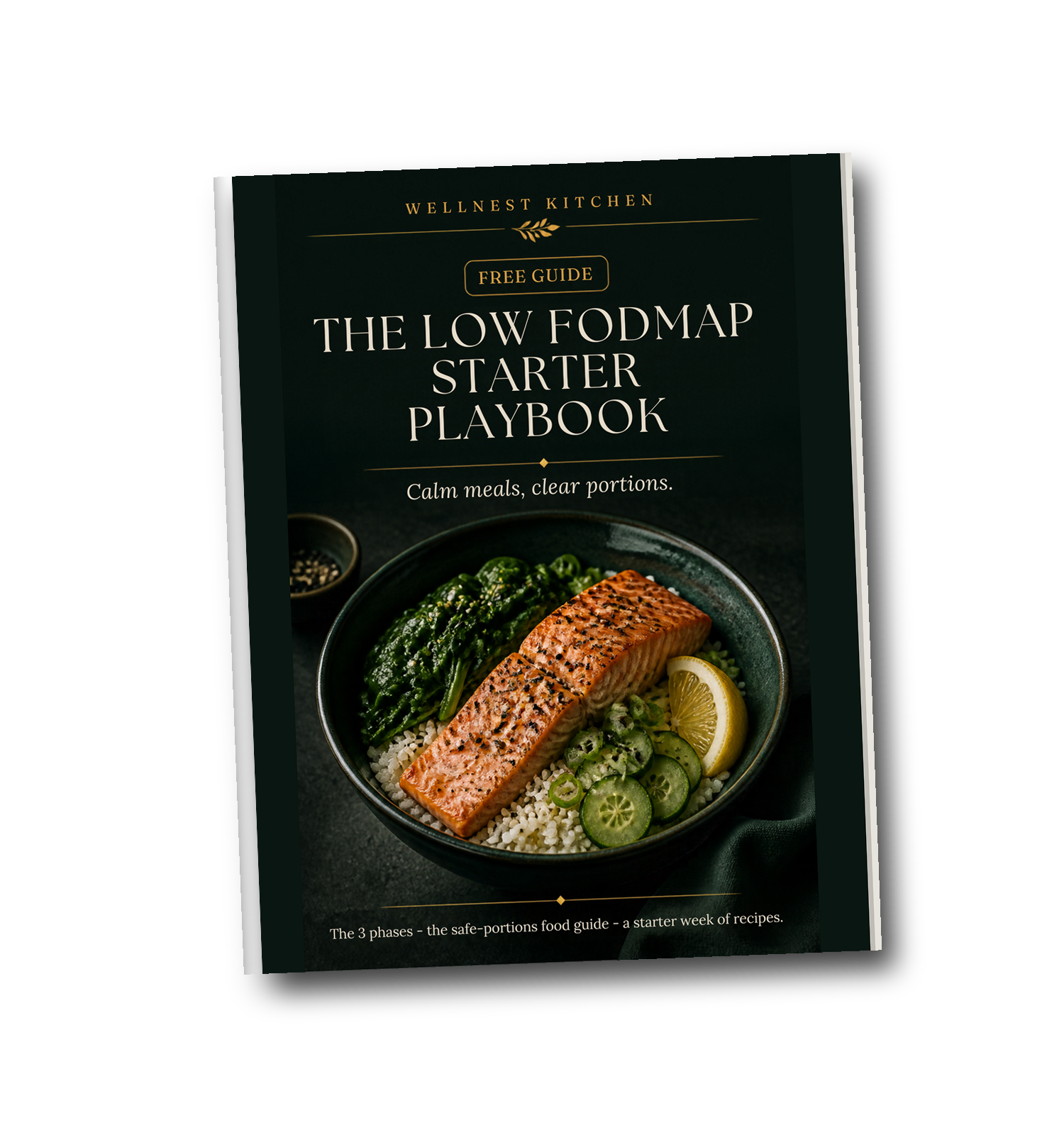
Get the Free FODMAP Ebook
Join the WellNest newsletter and get the free ebook - 109 foods rated the Monash way, 10 starter recipes with portion checks, and a simple plan for your first weeks. The full pack by email: the Low FODMAP Starter Playbook ebook + a printable food chart and a first-week grocery list. Free, always.